
If you own a rental property in San Diego, you’ve probably seen the Instagram ads. A polished pitch from a company called AveryIQ(also marketed as callavery.com) telling small landlords they don’t need a property manager anymore - they just need Avery, an AI agent that answers calls, schedules tours, opens work orders, and chats with tenants in 14 languages. Fire the PM. Save the 8%. Scale your portfolio. Welcome to the future of property management.
It’s a beautiful pitch. It is also, in my professional opinion as a licensed California real estate broker, the most expensive piece of software a San Diego landlord can possibly subscribe to - because the moment you replace your property manager with a chatbot, you personally absorb 100% of the operational, legal, and fiduciary risk a licensed company would otherwise carry on your behalf.
This is an honest AveryIQ review from someone who runs a property management company, holds a California DRE broker’s license, and uses AI tooling daily inside our brokerage. I’ve personally closed over $150 million in real estate transactions. I am exactly the kind of operator who should be cheering AveryIQ on. I’m not. Here’s why.
Stop Outsourcing Your Liability
In the 2026 San Diego regulatory environment, one fair housing complaint, one botched showing, or one missed security deposit deadline can cost you more than a decade of management fees.
Schedule a Free ConsultationWhat Is AveryIQ?
AveryIQ is a SaaS company offering an AI agent named Avery that handles property management tasks - leasing calls, tour scheduling, work orders, tenant communications, and basic accounting. The platform is also marketed at callavery.com. Their Pro plan is explicitly positioned at landlords with 10 to 300 units as a replacement for a traditional property management company, with the pitch being that the AI pays for itself by letting you skip the 8% management fee.
That’s the marketing. Here is what AveryIQ does not put in the ad copy: the moment you self-manage, you personally absorb 100% of the operational, legal, and fiduciary risk that a licensed property management company would otherwise carry. The AI does not take any of that risk. AveryIQ does not take any of that risk. You do. Every word the chatbot says to your tenants, every work order it dispatches, every late fee it assesses, every fair housing question it answers in real time - you are legally on the hook for. AveryIQ has a Terms of Service and a disclaimer. You have a portfolio and a personal balance sheet.
That asymmetry is the entire business model. They collect the subscription revenue. You inherit the lawsuits.
AI-Scheduled Tours
AveryIQ proudly advertises that Avery schedules tours and handles leasing conversations end to end. The pitch is that a chatbot can move a prospect from inquiry to scheduled tour to lease signing without a human in the loop. Let’s walk through what that actually means in practice.
Modern self-showing technology is a useful tool - Palm Tree Properties itself uses Tenant Turner inside our leasing workflow because it accelerates qualified showings and improves the prospect experience. The reason it works in our hands is that there is always a human on the other side. Our team reviews every prospect before access is granted, monitors the showing in real time, fields calls from neighbors or the prospect mid-tour, and can physically dispatch someone to the property within minutes if something looks wrong. The technology is the front door. A licensed leasing professional is the safety net behind it.
That safety net is exactly what AveryIQ removes. When the entire leasing pipeline is run by an autonomous AI agent, no one is watching. The AI qualifies the prospect, the AI grants access, the AI marks the tour “complete” - and there is no human reviewing any of it. If the prospect props the door open, props the door for someone else, slips and falls, leaves the stove on, or never actually shows up at all, the AI does not know. The workflow status flips to “complete” and attention ends.
A human leasing professional - backed by self-showing technology, not replaced by it - notices the dozen small signals that distinguish a real renter from a scammer or a property scout. They notice that the “prospect” asked weirdly specific questions about the locks before the tour. They notice the ID on file does not match the inquiry pattern. They notice when a neighbor calls to say the door is hanging open at 9 p.m. None of that signal makes it into Avery’s prompt window. None of it ever will.
Self-Showing Without a Human Is Self-Showing Without a Safety Net
A typical AI-only leasing flow grants property access to a prospect ID-verified by software, then marks the tour complete when the door re-locks. If that prospect returns with associates, if they fail to lock up, if they damage the unit, if a neighbor reports suspicious activity during the tour - there is no licensed human watching the dashboard, no one to call the police, no one to dispatch to the property, no one with legal authority to remove an unauthorized occupant. The same technology used inside a licensed brokerage with active human monitoring is a productivity tool. The same technology used as a replacement for human oversight is an unsupervised access system on a tenant-occupied or vacant asset. Those are not the same product.
AI Work Orders
Here is AveryIQ’s other big pitch: tenants call, Avery walks them through common fixes, opens work orders, and coordinates with vendors. Sounds great on a landing page. Let’s run it through reality.
A tenant calls and says “my dishwasher is leaking.” A real property manager runs a mental decision tree built from a thousand previous calls:
- Is this a second-floor unit? If yes, this is a $40,000 water damage event in 90 minutes - dispatch now, call the downstairs neighbor before they call us.
- Has this same tenant called about this same issue before? Then the previous repair didn’t take and the vendor needs to come back on warranty, not on a new invoice.
- Is the building old enough that “the dishwasher” might actually be a corroded supply valve about to flood the whole stack?
- Is this the tenant who calls about everything because they’re building a paper trail for a habitability defense?
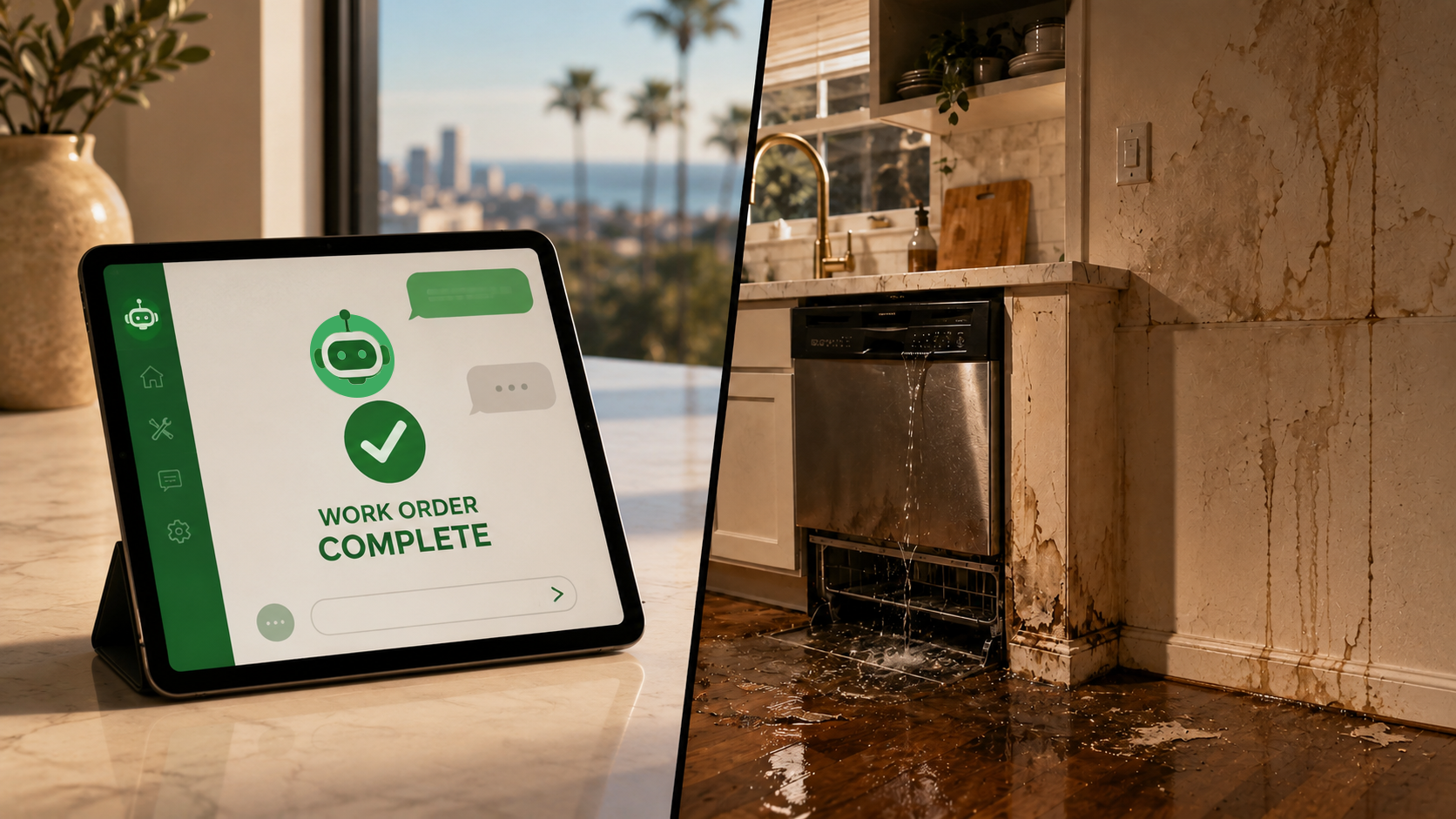
Avery opens a work order, dispatches the cheapest vendor on its approved list, and sends a confirmation text. Vendor shows up two days later, replaces a hose, leaves. Two weeks later the actual problem - a slow pinhole leak behind the cabinet - destroys the subfloor, soaks the drywall, and you discover it when the unit downstairs reports a ceiling collapse. Insurance fights you on coverage because the loss was “ongoing and known.” You eat $35,000 out of pocket.
The AI did not misdiagnose because it is stupid. It misdiagnosed because diagnosis is not a language task - it is pattern recognition built on physical intuition, building knowledge, and tenant history that lives in an experienced manager’s head and nowhere else. A real PM walks the property. A real PM remembers that Unit 4 has had three plumbing calls in six months and the supply lines need to be evaluated, not patched. None of that institutional memory fits in a prompt window.
Fair Housing
This is the one that should genuinely terrify every San Diego owner considering an AI-only property management setup.
Fair housing law is not intuitive. It is not friendly. It does not forgive good intentions. Saying the wrong thing to the wrong applicant - even a sentence that sounds completely innocent - is a five-figure HUD complaint and a federal lawsuit. “This neighborhood is great for families.” “We have a lot of young professionals here.” “I don’t think this unit would be a good fit for you.” Every one of those is a violation. Every one of those is exactly the kind of phrase a general-purpose language model will produce, with confidence, when a chatty prospect asks the wrong question.
And here is the part AveryIQ’s marketing carefully avoids: “the AI said it” is not a legal defense. You, the landlord, are vicariously liable for every word your leasing agent - human or otherwise - communicates to a prospect. HUD does not care that a language model wrote the response. Your insurance carrier does not care. The plaintiff’s attorney definitely does not care. You will be sitting in a deposition explaining to a federal investigator why your unlicensed software told a Section 8 voucher holder that the unit “probably wouldn’t be the right fit.”
It gets worse. AI systems are inconsistent in ways human managers are not. The same model can give Applicant A a friendly tour invitation and Applicant B a vague brush-off based on subtle linguistic cues in their inquiry - cues that often correlate with national origin, race, or disability. That is called disparate impact, and it is actionable even when there is no intent and no malice. California’s Civil Rights Department enforces these standards rigorously, and a single inconsistency in how an AI responds across applicants can trigger an investigation.
When that complaint hits - and it will hit, the only question is which AveryIQ subscriber gets the first one - the company will issue a statement, update their FAQ, and keep selling subscriptions. You will be the one writing the settlement check.

Fair Housing Is Not a Feature
Palm Tree Properties maintains a documented “Criteria for Residency” applied consistently to every applicant, with current fair housing training across our entire team. A chatbot cannot replicate that.
Schedule a Free ConsultationSecurity Deposits
Since you are self-managing, traditional broker trust accounting does not technically apply to you. A different - and arguably worse - version of the same problem does, because nobody is watching.
In California, security deposits are not your money. They belong to the tenant. Under AB 12 (effective July 2024), most security deposits are now capped at one month’s rent. Under longstanding California Civil Code §1950.5, deposits must be returned within 21 days of move-out, itemized, with receipts for any deductions over $125, or you owe the tenant up to twice the deposit as a statutory penalty plus attorney fees.
Are you confident your AI agent is tracking, segregating, and accounting for those deposits properly across every unit, every move-in, every move-out, every statutory deadline? Are you confident the security deposit money is not sitting in the same checking account as your rent income, your personal mortgage payment, and the Venmo your kid sent you for lunch money? Because the second a tenant sues - and they will - the first discovery request is your bank statements. Commingling alone is enough to lose the case.
Then there are the 1099s. Avery dispatches a vendor and pays the vendor. Did Avery collect a W-9 from that vendor? Did it track cumulative payments across the year to identify which vendors crossed the $600 threshold? Did it generate and file 1099-NECs by January 31? If not, the IRS penalty is up to $310 per missed form - plus disallowance of the deduction if they get aggressive. Multiply that by every vendor across every property.
Then there is the difference between a capital improvement and a repair, passive activity loss limits, depreciation schedules, and the dozens of other landlord-specific tax mechanics that turn a profitable rental into a tax disaster if mishandled. Avery is not your CPA. Avery generates a clean-looking P&L that your accountant will spend six billable hours unwinding in March.
You saved 8% on management fees. You spent it on tax prep, IRS penalties, and a security deposit lawsuit.

The Follow-Up
The dirty secret of property management is that 80% of the value isn’t doing the big things. It’s following up on the small things.
Did the vendor actually fix it, or did they say they did? Did the tenant confirm? Did the rent payment clear, or did it just get initiated and bounce three days later? Did the prospect who toured on Saturday get a follow-up call on Monday? Did the lease renewal notice go out 60 days before expiration, or 59 (which in California means you cannot raise the rent)? Did the smoke detector batteries get checked at the annual inspection? Did the 21-day security deposit accounting actually go out?
These are the cracks where money falls through the floor. These are exactly the cracks AI systems are worst at, because the bot does not care. It does not have a quota. It does not have a boss. It has a workflow, and when the workflow status flips to “complete,” attention ends.
| Failure Pattern | What AI Does | What a Real PM Does |
|---|---|---|
| Work order completion | Marks closed when vendor reports done | Walks the unit to verify the repair |
| Cold leads | Auto-reply, then nothing | Personal follow-up within 24 hours |
| Habitability complaints | Status update to tenant | Documentation trail for court defense |
| Lease renewal notice | Templated send on due date | 60-day notice with rent-cap analysis |
| Move-out accounting | Generic security deposit report | Itemized statement, certified mail |
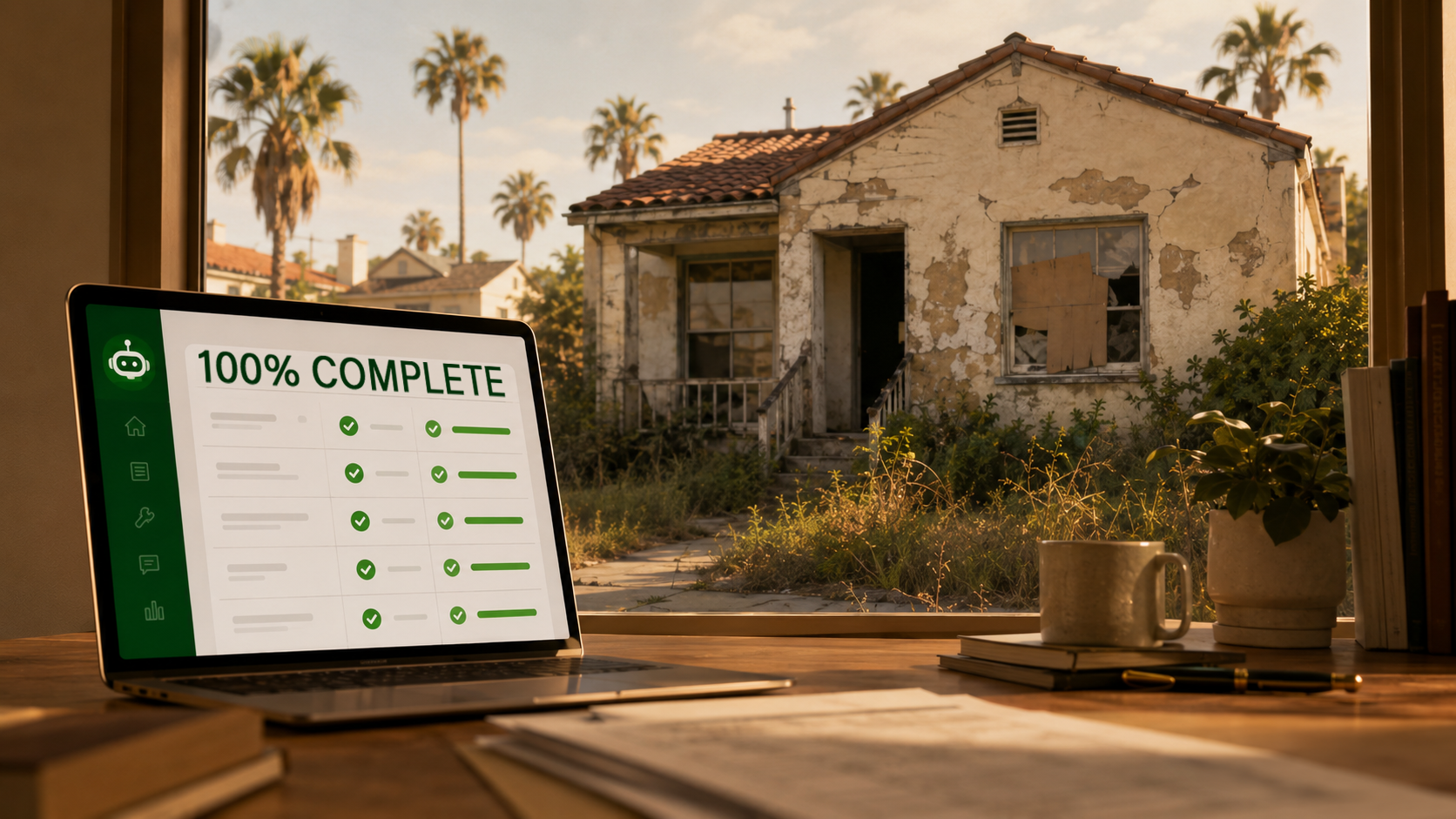
I have audited self-managed San Diego portfolios that ran on “automated” systems. The pattern is identical every time: the dashboard looks fantastic, the property looks like a disaster.
What You’re Really
Let me say it plainly: AveryIQ is not selling you a property manager. AveryIQ is selling you the appearance of a property manager while quietly transferring 100% of the operational, legal, and fiduciary risk from a licensed company onto your personal balance sheet.
A real San Diego property management company carries what software cannot:
- A subscription fee
- A Terms of Service disclaimer
- A chatbot that closes tickets
- No license, no bond, no insurance
- No accountability when it breaks
- California DRE Broker License #01984056
- E&O insurance coverage
- Annual fair housing training, all staff
- Vetted vendor relationships, 10+ years
- A human you can call who is accountable
There is a reason California requires a Department of Real Estate broker’s license to manage property for compensation. It is not gatekeeping. It is because the job involves fiduciary duties, fair housing law, statutory deadlines, and decisions that can financially ruin owners if handled incompetently. A chatbot with a 14-language toggle does not satisfy any of those requirements. It just hides them behind a friendly UI.

AveryIQ FAQ
What is AveryIQ?
AveryIQ (also marketed as callavery.com) is a SaaS company offering an AI agent named “Avery” that handles property management tasks including leasing calls, tour scheduling, work orders, tenant messaging, and basic accounting. Their Pro plan is marketed to landlords with 10 to 300 units as a replacement for a traditional property management company.
Is AveryIQ a good replacement for a property management company?
Not for most landlords. The software itself is well-built, but using it to replace a licensed property manager means the landlord personally absorbs 100% of the legal, fiduciary, and operational risk a licensed company would otherwise carry. That includes fair housing exposure, security deposit law compliance, habitability defense, and trust accounting obligations. The AI does not hold a real estate license, does not carry E&O insurance, and cannot be held legally accountable.
How much does AveryIQ cost?
AveryIQ offers tiered plans by portfolio size. Their Professional plan includes 2,500 SMS messages and 1,200 call minutes per month, with overages at $0.025 per message and $0.02 per minute. The Starter plan does not include phone, SMS, or calling features. The published pricing positions Avery as cheaper than a property management company on its face - but the hidden cost is the legal exposure transferred to the landlord.
Is it legal to self-manage my San Diego rental?
Yes. California law allows owners to manage their own properties without a broker’s license. The license is only required when you manage someone else’s property for compensation. The legal exposure described in this article applies to any self-managing landlord, with or without AI tools - AveryIQ does not create the exposure, but it can scale how often you encounter it.
Doesn’t Palm Tree Properties use self-showing technology too?
Yes. We use Tenant Turner to streamline qualified showings - but every prospect is screened before access is granted, every showing is monitored by our team in real time, and we can physically dispatch someone to the property if anything looks off. The technology is a tool inside a supervised process, not a replacement for the supervision itself. That is the entire difference between using AI responsibly and the AveryIQ pitch of removing the human from the loop entirely.
What if I already subscribe to AveryIQ - should I cancel?
If you are using it as an internal tool to help you communicate with tenants while you remain the manager of record and you handle fair housing, deposit accounting, and follow-up yourself - it can be a useful productivity tool. If you are using it as a replacement for professional management and you are not actively supervising every interaction, you are exposed. The transition to a licensed manager takes about two weeks and Palm Tree handles the entire onboarding.
Do AI tools actually cause fair housing violations, or is that theoretical?
It is not theoretical. HUD has issued guidance specifically warning housing providers that they remain liable for fair housing violations committed by AI systems acting on their behalf. Several major class-action lawsuits are already in progress against larger AI leasing platforms. The case law is developing fast, and the early signals all point in the same direction: the landlord pays, not the software.
What’s the single biggest risk of replacing a property manager with AveryIQ?
Disparate impact in leasing communications. It is silent, it is documented, and it generates HUD complaints that settle for $25,000 to $75,000 per applicant before legal fees. Every other risk in this article - water damage, security deposit suits, IRS penalties - is recoverable. A federal fair housing judgment on your record is not.
What does Palm Tree Properties charge?
Our management fee is 8% of collected rent, with no inspection fees, no renewal fees, and no maintenance markups. Leasing fee is 50% of one month’s rent. Onboarding is a one-time $395 setup. That’s the entire fee schedule. No surprises. See our full pricing page for details.
Next Steps
Technology should make property management better, not eliminate the licensed operator who absorbs the legal risk. At Palm Tree Properties, we use the same kind of AI and automation tooling AveryIQ markets to consumers - except we deploy it inside a licensed brokerage with E&O insurance, fair housing training, vetted vendors, and a real human being whose name is on the door when something goes wrong.
If you own a rental in Chula Vista, Carlsbad, Encinitas, La Jolla, Pacific Beach, or anywhere across San Diego County - and you are tempted by a $99/month AI promise - please at least have a 15-minute conversation with us first. We will give you a straight answer about whether professional management makes sense for your specific situation. If it does not, we will tell you that.

Maximize Cashflow.
Palm Tree Properties is an owner-operated boutique brokerage built for serious San Diego landlords. We manage every property as if it were our own.