
Evicting a tenant in San Diego is high-stakes - here’s how to do it legally
If a tenant stops paying rent, violates the lease, or creates ongoing problems, it’s natural to want a fast solution. But in California, “fast” and “eviction” rarely go together - especially when the notice is incorrect or served improperly.
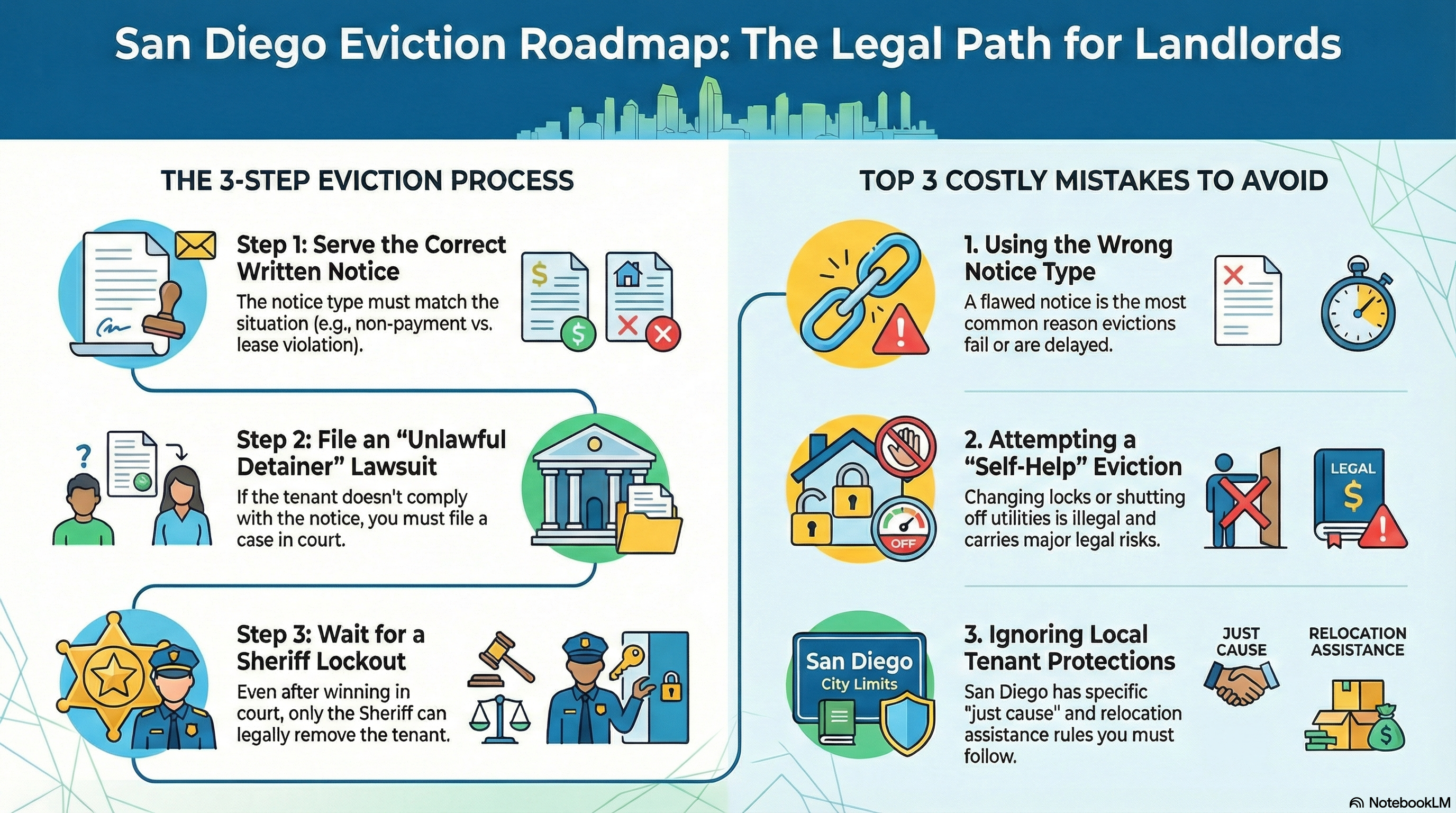
In San Diego, eviction is a formal court process known as an unlawful detainer. Landlords generally cannot force a tenant out, change locks, shut off utilities, or remove belongings on their own. The law requires a specific sequence of steps, and mistakes often lead to delays or dismissed cases.
California Courts self-help resources provide a clear overview of how unlawful detainer cases work and why proper notice and service matter.
This guide breaks down:
- When you can legally evict (and when you can’t)
- Which notice to use
- How the court process typically works
- San Diego-specific tenant protection issues
- Common landlord mistakes that delay cases
Key Takeaways
- San Diego evictions require a formal court process called unlawful detainer; landlords cannot self-help by changing locks or shutting utilities.
- Using the wrong notice type or serving it improperly are the most common reasons eviction cases fail or get delayed.
- Evictions fall into “at-fault” (nonpayment, lease violations) and “no-fault” (owner move-in, remodel) categories, each with different legal requirements.
- No-fault evictions in San Diego may require relocation assistance and are heavily regulated by AB 1482 and local ordinances.
- True eviction costs extend beyond court fees to include lost rent, turnover costs, and risks from procedural mistakes causing dismissal.
When can a landlord legally evict a tenant in San Diego?
Evictions generally fall into two categories:
A) “At-fault” evictions
These apply when the tenant violates the lease or the law, including:
- Nonpayment of rent
- Breach of lease (unauthorized occupants, unauthorized pets, repeated noise complaints, etc.)
- Nuisance or illegal activity
- Significant property damage
B) “No-fault” evictions
These occur when the landlord ends the tenancy for a legally permitted reason that is not the tenant’s fault, such as:
- Owner or family move-in (in certain circumstances)
- Substantial remodel or removal from the rental market (depending on the rules that apply)
California’s just cause framework plays a major role here, particularly for long-term tenancies. Local ordinances can add additional restrictions or require relocation assistance.

Choosing the correct eviction notice (the most important step)
Many failed or delayed evictions come down to one issue: using the wrong notice or leaving out required information.
California Courts provides a helpful breakdown of common notice types and when they are used.
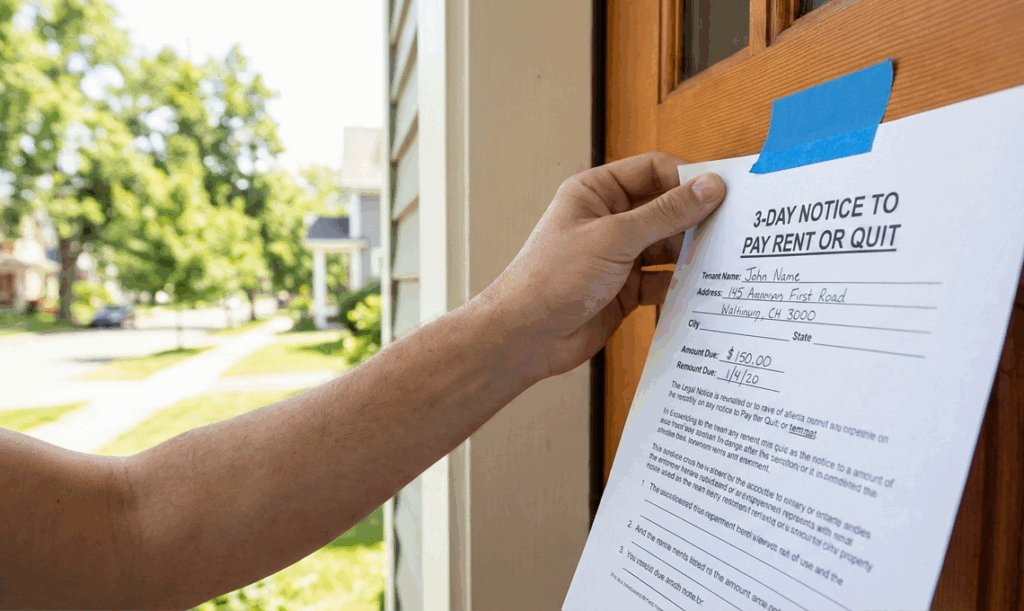
2.1) 3-Day Notice to Pay Rent or Quit
Use this notice when rent is past due and you are demanding payment or possession of the unit. Court guidance emphasizes that the notice must be written and include accurate, required details.
Common mistakes to avoid:
- Listing the wrong amount
- Including non-rent charges that shouldn’t be in the “rent owed” figure (fact-specific)
- Accepting partial payments in a way that complicates the claim (fact-specific)
2.2) 3-Day Notice to Perform Covenants or Quit (Cure or Quit)
Use this when the tenant violated the lease but can correct the issue, such as:
- Remove an unauthorized pet
- Remove an unauthorized occupant
- Stop prohibited behavior
This is often referred to as a “fix it or move out” notice.
2.3) 3-Day Notice to Quit (Unconditional)
This is generally reserved for serious violations where the landlord alleges the tenant must move out without a chance to “cure.” California Courts describes this as a 3-day notice used when the landlord claims the tenant seriously broke the lease.
2.4) 30-Day or 60-Day Notice to Quit
These notices are commonly associated with ending month-to-month tenancies - but they are not universally allowed due to just cause requirements (state and local). California Courts includes these notice types in its overview of possible notices.
San Diego note: AB 1482 and local tenant protections can limit no-fault terminations and may require relocation assistance.

Serving the notice correctly (another common failure point)
Even with the perfect notice, your case can be delayed if service isn’t done properly.
California Courts provides guidance on delivering an eviction notice and documenting how it was delivered. Understanding California eviction laws before you serve can help you avoid costly mistakes.
Best practice (operational):
- Use a consistent internal checklist for service
- Keep photos, timestamps, and copies of everything
- Maintain a clean rent ledger and communication log

San Diego eviction timeline: what to expect (typical path)
While every case is different, most evictions follow this general structure:
- Serve the correct notice
- Wait the notice period (example: 3 days for certain notices)
- File an unlawful detainer lawsuit if the tenant doesn’t comply
- Serve the court papers
- Tenant responds or doesn’t respond (affects timing)
- Hearing / trial or default judgment
- Sheriff lockout (if needed)
Unlawful detainer is the court process used to evict a tenant, and only the Sheriff can physically remove a tenant from the property after judgment.
Even if you win, the lockout is typically handled through the Sheriff after the court process. A California Superior Court self-help resource explains that the Sheriff can enforce the judgment. If you want to shorten this process, learn about legal ways to speed up the San Diego eviction process - and factor in what California evictions actually cost before you begin.
How the unlawful detainer court process works
Step 1: Filing the case
If the notice period expires and the tenant doesn’t comply, you can file an unlawful detainer case.
Step 2: Serving court papers
Proper service matters again here (just like notice service). Notice requirements in San Diego rentals follow strict rules that carry through to the court process as well.
Step 3: Tenant response or default
If the tenant does not respond, a default judgment may be possible (fact-specific). If they do respond, the case proceeds toward a hearing or trial. Understanding how property managers reduce legal risk for landlords can help you navigate these steps more confidently.
This university legal resource summary describes the basic flow: notice → unlawful detainer filing → tenant response → next steps.

Nonpayment evictions: the most common scenario
When rent is unpaid, landlords often want speed. In practice, the fastest route is following the rules precisely.
Operational checklist for nonpayment cases:
- Confirm your rent ledger is clean and accurate
- Verify that the amount demanded qualifies as “rent” (fact-specific)
- Serve a compliant Pay or Quit notice
- Document service and all communications
California Courts’ notice resources explain that Pay or Quit is used when the landlord believes the tenant is behind on rent.

Owner move-in and “no-fault” terminations in San Diego
Owner move-in evictions are heavily regulated
Key considerations:
- Whether the property is covered by AB 1482 just cause rules
- Whether the City of San Diego tenant protections ordinance and/or municipal code relocation provisions apply
- Required relocation assistance in certain no-fault scenarios (San Diego-specific). City materials describe relocation assistance amounts and eligibility.
Local regulations can significantly affect both timing and cost.
How much does an eviction cost in San Diego?
Most landlords think about attorney and court fees, but real eviction costs often include:
- Lost rent during the process
- Turnover costs (repairs, cleaning, vacancy marketing)
- Opportunity cost (your time)
- Risk cost if mistakes cause dismissal/refiling
Even a “successful” eviction can be expensive.

Common eviction mistakes that delay or derail cases
These are the issues we most often see with DIY evictions:
- Wrong notice type
- Improper service of the notice
- Poor documentation (no rent ledger, inconsistent texts/emails)
- Trying self-help (lockouts, utilities shutoff - major legal risk)
- Ignoring local protections (San Diego relocation rules / just cause overlay)

When hiring a property manager pays for itself
If you own a rental in San Diego and are dealing with:
- Chronic late payers
- Repeat lease violations
- Tenant conflict
- Fear of legal mistakes
Professional property management often costs less than a delayed or failed eviction.
A strong property management company helps with:
- Tenant screening (reduces eviction risk up front)
- Rent collection systems
- Proper notices and documentation
- Vendor coordination and compliance tracking
If you’re facing a tenant issue in San Diego and want a clear plan, Palm Tree Properties can help you understand your options, reduce risk, and manage the process end-to-end.

At Palm Tree Properties, we handle this type of situation every day, and we treat every property in the same way that we’d treat our own. We help San Diego landlords protect their investments and make sure that they’re following the laws that actually matter. If you’re looking for a property management company that knows this market inside and out and cares about bringing you the best possible returns, let’s talk. Request your free rental property evaluation and see what we can do for your investment. We also have plenty of resources available with more tips on how to run your San Diego rental.
FAQ
- How long does an eviction take in San Diego?
It depends on the notice type, tenant response, and court timing, but many cases take weeks to months. The unlawful detainer process is handled through the courts.
- Can I change the locks if the tenant stops paying?
Generally, landlords must use the court process; physical removal is typically enforced by the Sheriff after judgment. - What notice do I use if the tenant didn’t pay rent?
Commonly, a 3-Day Notice to Pay Rent or Quit is used for nonpayment situations. Understanding how to handle problem tenants in San Diego can help you navigate these situations more effectively.