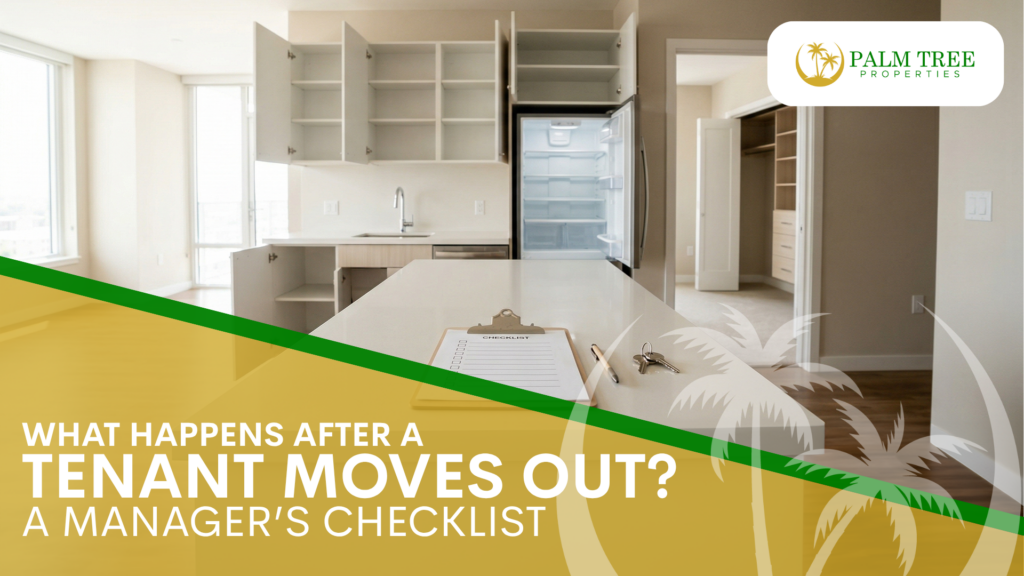
For many San Diego rental owners, the period between tenants is the most volatile phase of property ownership. It is the moment when cash flow stops and operational expenses spike. However, as professional asset managers, we view the tenant move out process in San Diego as a critical operational window to reset lease standards, preserve property condition, and stabilize long-term income.
In the 2026 San Diego rental market, where median rents remain among the highest in the nation, a slow or disorganized turnover is a direct attack on your Net Operating Income (NOI). With San Diego median rents hovering near $2,998 per month, every day your property sits empty is approximately $100 in realized wealth vanishing. A 30-day delay in turnover represents a 2.7% annual return reduction on a $1M asset. A disciplined turnover doesn’t just “fill the unit”; it protects the owner’s equity by reducing downtime and ensuring the next resident meets our rigorous 3x rent income standards.
Stop the Financial Bleed: Schedule a Residential Property Management Consultation
Missing the 21-day security deposit deadline can expose you to statutory penalties of twice the amount of the deposit. Protect your asset with a professional turnover audit.
The Financial Erosion of a Delayed Turnover
In San Diego, vacancy is a “localized total loss.” Unlike a stock that might rebound, a day of lost rent is a total loss on that asset’s timeline. We treat every turnover as a clinical operation because the math of underperformance is devastating.
The Math of Vacancy
If your property in Carmel Valley (92130) or Scripps Ranch (92131) rents for $4,500 per month, every week of vacancy costs you $1,038. If a DIY landlord takes 45 days to turn a unit-common when juggling personal schedules and unreliable vendors-the loss exceeds $6,750. This doesn’t include the “utility carry,” where responsibility for SDGE and water reverts to the owner, often adding another $400 to $600 to the monthly vacancy bill.
The Cost of Underpricing vs. Overpricing
Underperformance also manifests in pricing errors. If your property in Mira Mesa (92126) is underpriced by just $250 per month, you are losing $3,000 annually in pure profit-an amount that often exceeds a full year of professional management fees. Conversely, overpricing by $200 can lead to an extra month of vacancy, costing you $4,000+ to “chase” an extra $2,400 in annual rent. We use a data-driven Rental Market Analysis to hit the “Sweet Spot” from Day 1.
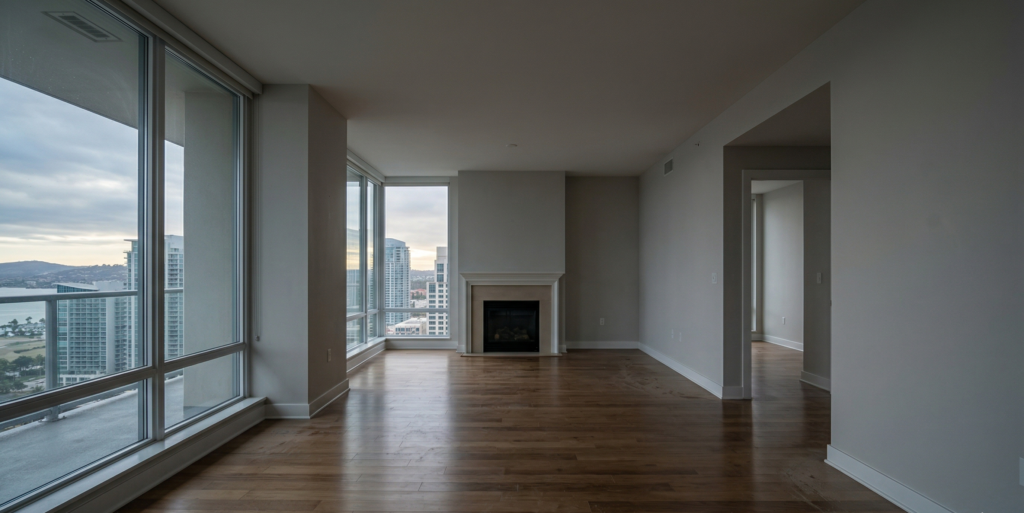
Vacancy Risk by Asset Type in San Diego
Your exposure to vacancy and turnover costs is not just about the neighborhood; it is about the asset class.
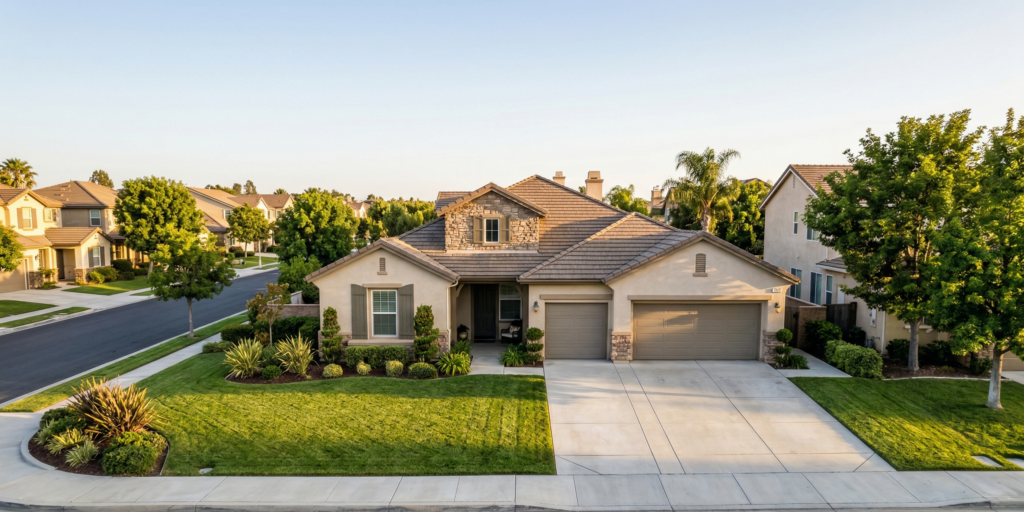
Single-Family Homes (SFR)
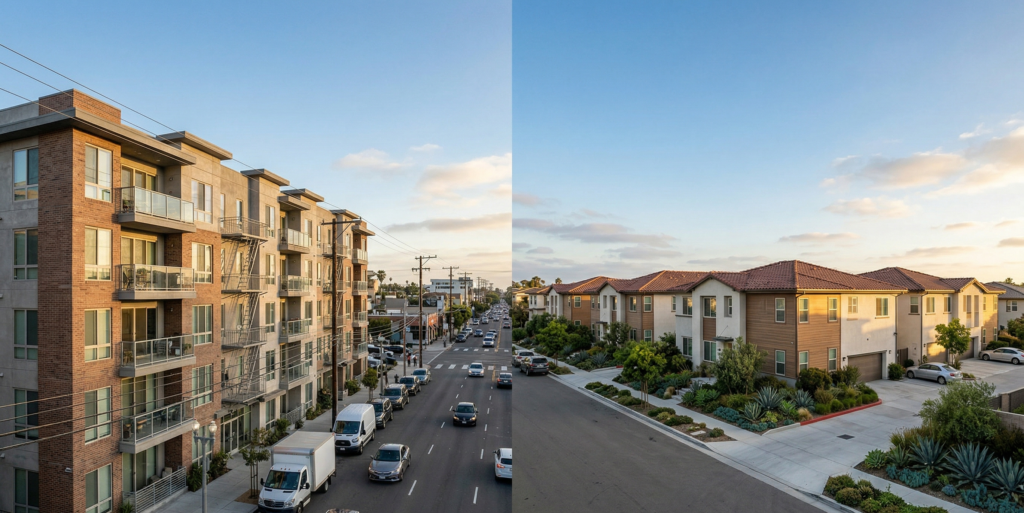
In suburban corridors like the I-15 (92131, 92127), single-family homes typically see the longest tenancies (3-5 years). However, the turnover cost is the highest. Turning a 2,500 sq. ft. home involves significantly more paint, flooring, and landscaping prep than a condo. The risk here is “Turnover Shock,” where an owner is hit with a $5,000+ make-ready bill after years of steady cash flow.
Condos and Townhomes
Condos in University City (92122) or Mission Valley (92108) face “HOA Friction.” Moving trucks must be scheduled, gate codes updated, and elevator deposits paid. Vacancy risk is moderate, but the “move-in fee” or HOA-imposed move-out rules can add 2-4 days of administrative delay if not managed with discipline.
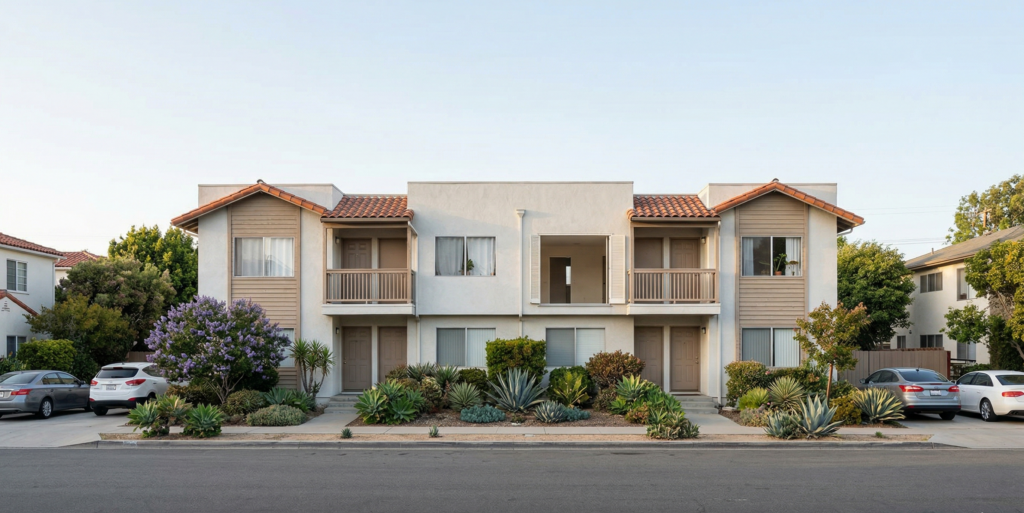
Small Multifamily (2-20 Units)
Properties in North Park (92104) or Pacific Beach (92109) experience higher turnover frequency. The demographic is more transient, making a standardized, rapid turnover system the only way to maintain a profitable cap rate. In these high-density areas, missing a “Summer Surge” leasing window (May-August) can lead to a property sitting vacant through the slower winter months.
The Psychological Cost: Pressure Leads to Bad Decisions
Financial erosion is objective, but the psychological cost of vacancy often causes the most long-term damage to an owner’s portfolio.
The “Desperation” Hire
When a property sits vacant for 45 days, owners often experience “Pricing Panic.” This leads to a dangerous compromise: lowering screening standards. Accepting a “marginal” tenant just to stop the bleeding is the primary cause of future evictions. An eviction in San Diego County currently costs between $8,000 and $15,000 when factoring in legal fees, lost rent (3-6 months), and property damage.
Deferred Maintenance Procrastination
Owners who manage their own properties often “patch” problems during a turnover to save cash. This procrastination leads to compounding maintenance debt. A small leak ignored during a tenant turn in 2026 becomes a $10,000 mold remediation project in 2027. We operate with expense discipline, but we never compromise on asset protection.

Our 14-Day “Asset-First” Turnover System
We treat every turnover as a clinical operation. By the time the keys reach our office, our vendor network is already dispatched.
Phase 1: Possession & Initial Assessment (Day 0-2)
The moment the tenant vacates, the clock starts. We conduct a room-by-room move-out inspection, distinguishing between “Normal Wear and Tear” and “Tenant Damage.” In 2026, we specifically audit for Habitability Standards (AB 628), which require landlords to maintain working stoves and refrigerators in all residential units.
Phase 2: The “Make-Ready” Sequence (Day 3-7)
- Day 3-4: Painting and flooring repairs.
- Day 5: Professional deep cleaning and window tracks.
- Day 6: HVAC servicing and filter swap.
- Day 7: Horticultural refresh and curb appeal audit.
Phase 3: Marketing & Lease Execution (Day 8-14)
We use professional wide-angle photography and 3D walkthroughs to minimize “looky-loo” showings and attract serious, high-income leads. Our [Internal Link: Tenant Screening Process] ensures the new resident meets our strict credit and income standards before the keys are handed over.
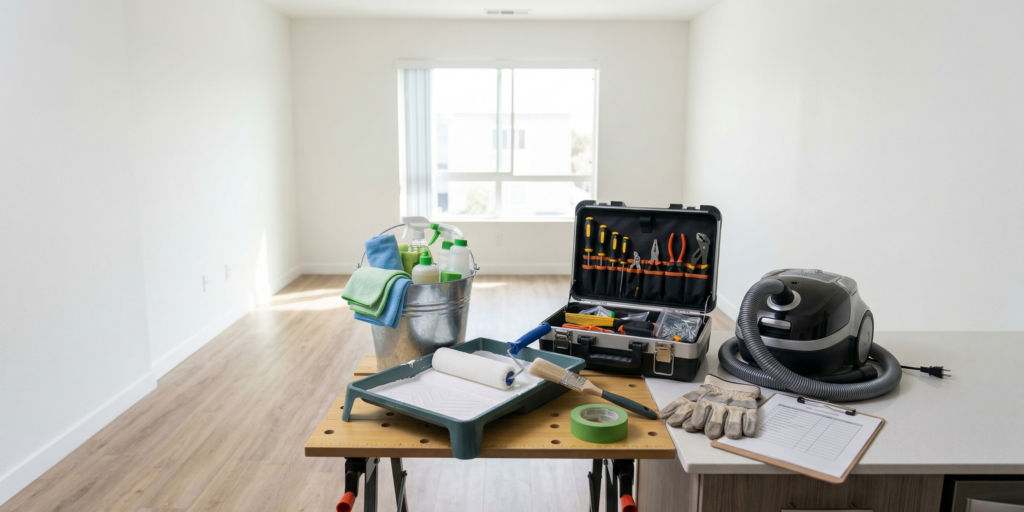
The Definitive 2026 Tenant Move-Out Checklist
Use this 30-point operational diagnostic tool to audit your current turnover process.
Administrative & Legal Compliance
- Confirm written 30-day notice from all adult occupants.
- Provide “Move-Out Requirements” PDF (Cleaning & Repair standards).
- Offer Pre-Move-Out Inspection (Civil Code 1950.5 compliance).
- Confirm tenant’s forwarding address for the 21-day mailing.
- Perform final [Internal Link: Rental Market Analysis San Diego] for 2026 rent positioning.
- Document “Before” photos for deposit reconciliation (Mandatory 2026 update).
- Review ledger for any outstanding late fees or unpaid utility bills.
Physical Condition & Habitability
- GFCI Test: Verify safety outlets in kitchen and bathrooms.
- HVAC Audit: Replace filters and verify heating/cooling functionality.
- Water Heater: Verify seismic straps and pressure relief valve.
- Exterior Drainage: Ensure gutters and downspouts are clear of debris.
- Window Verification: Ensure all window locks and screens are functional.
- Garage Door Safety: Test auto-reverse sensors and spring tension.
- Appliance Audit (AB 628): Confirm stove and refrigerator are working.
- Plumbing Stress Test: Check under-sink valves and toilet seals for slow leaks.
Marketing & Re-Leasing
- Professional photography refresh (mandatory if older than 24 months).
- 3D Walkthrough refresh to facilitate remote high-income leads.
- Pre-load showing calendar for automated or agent-led tours.
- Update lease template with 2026 San Diego specific disclosures.
- Update smart lock codes and verify lockbox placement.
Risk & Financial Reconciliation
- Re-Key Property: Professional locksmith dispatch for all exterior doors.
- Smoke/CO Detectors: Replace all batteries and test functionality.
- Insurance Review: Notify carrier if vacancy will exceed 30 days.
- Deposit Itemization: Collect all vendor receipts for the $125 threshold rule.
- Final Statement: Mail itemized statement and funds via Tracked First-Class Mail.
- Pest Control: Perform a preventative interior/exterior spray while vacant.
- Irrigation Check: Ensure landscaping doesn’t die during the vacancy.
- Light Bulb Audit: Replace all burnt-out bulbs with matching LEDs.
- Cabinet Hardware: Tighten all loose hinges and handles.
- Final Walkthrough: Perform a “white glove” check before the first showing.
Security Deposit Compliance: The California 21-Day Rule
In San Diego, the security deposit reconciliation is a legal minefield governed by California Civil Code Section 1950.5. A landlord has exactly 21 calendar days after the tenant moves out and returns the keys to provide a full refund or an itemized statement of deductions.
The 2026 Compliance Standards
As of 2026, if a tenant paid rent or their deposit electronically, landlords are generally required to return the remaining deposit electronically if requested. You must provide copies of receipts for any repair or cleaning that exceeds $125. If the work cannot be completed within 21 days, you must provide a good-faith estimate and then follow up with a final statement within 14 days of completion.
Failure to follow these protocols is not just an “oops.” If a court finds you withheld a deposit in “bad faith,” you can be liable for the actual loss plus statutory damages of up to twice the amount of the deposit. On a $4,000 deposit, a simple clerical error could cost an owner $12,000 ($4k original + $8k penalty).

What Happens If a Tenant Disputes the Deposit?
Fights over security deposits make up a large percentage of the landlord-tenant disputes in the San Diego Superior Court. When a tenant challenges your deductions, the burden of proof is entirely on the landlord.
Documentation Standards
If a tenant sends a demand letter, you must be prepared to defend your deductions with:
- The Comparison Report: Side-by-side photos of the move-in condition vs. the move-out condition.
- Professional Receipts: Invoices showing the work done, the date, and the hourly rate or materials cost.
- The Useful Life Argument: You cannot charge a tenant for the full cost of new carpet if the old carpet was 5 years old. In California, most courts use a 5-year life for carpet and 2-3 years for paint.
The Small Claims Process
If mediation fails, the tenant may sue in Small Claims Court (claims up to $12,500). We represent our owners’ interests by preparing a comprehensive “Evidence Packet” that tells the story of the tenancy chronologically. Most landlords lose in court not because their deductions were unfair, but because their documentation was disorganized.

San Diego Regulatory Depth: City vs. County “Just Cause”
The 2026 regulatory environment in San Diego requires an understanding of local “Just Cause” overlays.
- City of San Diego Residential Tenant Protections: This ordinance is stricter than the statewide AB 1482. In the City of San Diego, “Just Cause” protections often apply from Day 1 of a tenancy, whereas the state law typically kicks in after 12 months.
- Relocation Assistance: For no-fault evictions (like an owner move-in), City of San Diego landlords must pay 2 to 3 months’ rent in relocation assistance, compared to the 1-month requirement under state law.
- 2026 Rent Cap: For properties subject to AB 1482, the rent increase for San Diego County is currently capped at 8.8% (5% + CPI). Miscalculating this during a lease renewal is a common cause of tenant disputes during the move-out process.
What Typically Goes Wrong with Underperforming Managers
Many owners hire managers who “oversee” turnovers rather than “operating” them. Common failures include:
- Missing the 21-Day Deadline: Forfeiting the owner’s right to withhold for damages.
- Poor Vendor Oversight: Allowing “general” handymen to charge premium rates for substandard work.
- No Pre-Move Out Inspection: Missing the chance to let the tenant fix issues, leading to longer vacancies.
- Delinquency Tolerance: Allowing the tenant to “live out their deposit,” leaving zero funds for make-ready repairs.
- Passive Marketing: Only posting on the MLS and waiting for the phone to ring, rather than aggressively syndicating across 50+ portals.

Switching Property Management Companies
If your current manager is struggling with turnovers or leaving your home vacant for 30+ days, switching is a systemized process. We specialize in taking over assets during a move-out window to stabilize the income.
Our transition plan includes:
- Documentation Audit: We review all move-in reports and ledgers for accuracy.
- Lease Standard Reset: We implement our professional standards for all upcoming tenancies.
- Vendor Transition: We move the turnover work to our trusted network to shave 10-14 days off the timeline.
- Delinquency Stabilization: We resolve any lingering unpaid rent or utility bills left by the previous management.
Fees & Pricing: The Performance Perspective
San Diego property management fees typically fall between 8% and 10% of monthly rent. While “low-cost” managers may charge 6%, they often lack the systems to manage a rapid 14-day turnover.
Consider this: A manager who charges 1% more ($45/mo) but fills your unit 21 days faster ($3,150 in rent) has paid for their entire annual fee in a single turnover. At Palm Tree Properties, we emphasize Performance-Based ROI. Our systems are designed to pay for themselves by protecting your Net Operating Income.
FAQ
- What is the 21-day security deposit rule in California?
Landlords have 21 calendar days from the day keys are returned to provide a full refund or an itemized statement of deductions with receipts. - What is considered normal wear and tear in California?
Standard aging that occurs without abuse or negligence, such as carpet fading from sunlight or minor scuffs on walls. It cannot be deducted from a deposit. - Can I charge for painting after a tenant moves out?
Only if the paint was damaged beyond normal wear or if the tenant was there for less than the “useful life” of the paint (typically 2-3 years). The charge must be prorated. - What happens if I miss the deposit deadline?
You lose the right to withhold any portion of the deposit and could be sued for “bad faith” retention, resulting in penalties of up to twice the deposit amount. - Should I allow a pre-move-out inspection?
Yes. California law requires you to offer it. It allows the tenant to fix problems before they become deductions, often speeding up your turnover. - How long does eviction take in San Diego County?
An uncontested case takes 6-10 weeks. A contested case can take 4-6 months. Rigorous screening is your best defense. - Can I increase rent after turnover under AB 1482?
Yes. If a unit becomes vacant, you can reset the rent to the current market value. AB 1482 rent caps (8.8% in San Diego for 2026) apply only to existing tenants. - Who pays utilities during vacancy?
The owner is responsible for all utilities (water, SDGE, trash) once the tenant moves out to ensure the property remains habitable for showings. - What maintenance should be done during every turnover?
At minimum: Re-keying, HVAC filter swap, battery swap on smoke/CO detectors, professional deep clean, and paint touch-ups. - How do I prevent vacancy longer than 14 days?
By beginning marketing 30 days before move-out, using a “5/5/14” pricing protocol, and pre-scheduling vendors before the unit is vacant. - Is a 3D walkthrough really necessary?
In 2026, yes. High-income tenants moving from out-of-state for San Diego’s tech and biotech sectors often sign leases based on 3D media before they arrive. - What is the average turnover cost in San Diego?
For a 3BR SFR, expect $2,500 to $5,000 including cleaning, paint, and minor repairs. Professional management focuses on minimizing this through tenant retention. - How do military relocations (PCS) affect San Diego turnovers?
Military families move on strict timelines. Most moves happen between May and August; missing this window can lead to extended winter vacancies.
Next Steps for San Diego Landlords
The tenant move out process in San Diego is a critical operational bridge. Don’t let a weak manager or lack of systems erode your rental income or expose you to legal penalties. Move to a firm that understands asset protection and performance-driven management.
Schedule a Residential Property Management Consultation
Protect your rental income with a performance-driven management strategy.