At Palm Tree Properties, we categorize turnover not as a “transition,” but as a Turnover Tax - a silent, unrecoverable drain on your equity. Our full analysis of the real cost of vacancy for San Diego rental owners quantifies what each additional day of downtime costs in your specific zip code.
Stop Paying the Turnover Tax
Our full analysis of the real cost of vacancy for San Diego rental owners quantifies what each additional day of downtime costs in your specific zip code.
Schedule a Free ConsultationThe Math of Misery: Quantifying the $6,000+ Turnover Event
Most DIY landlords assume a turnover costs a few hundred dollars for paint and a deep clean. In San Diego’s 2026 market, a standard move-out for a three-bedroom SFR is a $6,500 to $9,000 event. The cumulative effect of lost rent, marketing, make-ready labor, and utility carry has compounded sharply since 2024, and most owners only see the line items - not the total drain on annualized return.

The Breakdown of Realized Loss
| Cost Category | Range (2026) | Classification |
|---|---|---|
| Direct Revenue Loss | $3,000 - $4,500 | Vacancy |
| Marketing & Professional Media | $450 - $650 | Leasing |
| Make-Ready Blitz | $1,500 - $3,000 | Make-Ready |
| Utilities Carry | $400 - $600 | Carry |
With median rents for houses exceeding $140/day, a three-week turn is a $2,940 loss in raw cash. High-earning tenants now expect 3D Matterport tours and professional photography - not smartphone photos. Deep cleaning runs $600+, paint touch-ups add up quickly, and the mandatory Operability Audit of systems and appliances is no longer optional under California’s 2026 habitability rules. When the unit is empty, SDGE and water bills revert to the owner, and maintaining landscaping and climate control during showings is mandatory.
Investor Math: If your property generates a net profit of $1,200 per month after the mortgage, taxes, and insurance, a $6,500 turnover event wipes out nearly six months of hard-earned profit. This is the silent erosion that disciplined investors must measure - and eliminate - through clinical execution.
The 3 Most Expensive Turnover Mistakes San Diego Landlords Make
The vast majority of turnover losses are not driven by repair costs - they are driven by avoidable operator errors. The same three mistakes appear in nearly every distressed turn we audit across San Diego County.

Each of these mistakes shares a common root: reactive decision-making under time pressure. The fix is procedural - a written turnover playbook that removes emotion from pricing, scheduling, and screening decisions. Our team operates the same protocol across every property under management, which is why our average vacancy days remain in the single digits even in soft seasons.
The 2026 Regulatory Landscape: Managing the Litigation Shield
In 2026, the tenant turnover cost rentals incur is not just financial - it is a statutory litigation risk. California has moved toward a “zero-tolerance” environment for administrative errors during the turnover phase. Two new statutes in particular have changed how every move-out must be processed.

If you accepted the initial security deposit or any rent payments electronically, you are legally required to return the remaining deposit electronically unless both parties agree otherwise in writing. Mismanaging the 21-day itemized statement timeline under Civil Code §1950.5 can result in “bad faith” penalties of twice the deposit amount. On a $4,500 deposit, an administrative error is a $9,000 liability.
California law now codifies stoves and refrigerators as essential to habitability. If your turnover Make-Ready does not include a certified operability check of these appliances, a tenant can move in, claim a habitability breach, and legally withhold rent from Day 1. The exposure compounds when paired with deposit disputes.
Don’t Let an Administrative Error Cost You $9,000
Our team processes every move-out under a written compliance checklist that protects you from AB 414, AB 628, and Civil Code §1950.5 exposure.
Schedule a Free ConsultationThe Zero-Day Vacancy Protocol: An Operator’s Offensive
The most effective way to mitigate the tenant turnover cost rentals face is to eliminate the downtime entirely. We utilize a Pre-Leasing Strategy that turns the 30-day move-out notice into a 30-day marketing Show of Force - converting what most owners treat as a defensive period into an offensive one.

The 60-Day Renewal Trigger: We initiate renewal negotiations 90 days out. If the tenant is vacating, marketing begins 60 days before their move-out date.
Occupied Showings: With proper 24-hour notice per California Civil Code, we conduct high-impact showings while the unit is still occupied - capturing the peak interest window.
The A-Player Pipeline: We aggregate qualified applicants so a lease is signed before the current tenant has even packed their first box.
This protocol is the single highest-leverage change a San Diego owner can make. The mathematics are unambiguous: every day saved on the back end of a tenancy is one full day of rent retained, and every applicant pre-qualified before key return is one less day in which the owner carries utilities and risk.
San Diego Case Study: The 92131 Stabilization
The clearest demonstration of the protocol comes from a recent owner we onboarded in Scripps Ranch. Their numbers before intervention were typical of San Diego’s “passive management” tier - and the swing after intervention illustrates exactly where the lost dollars hide.
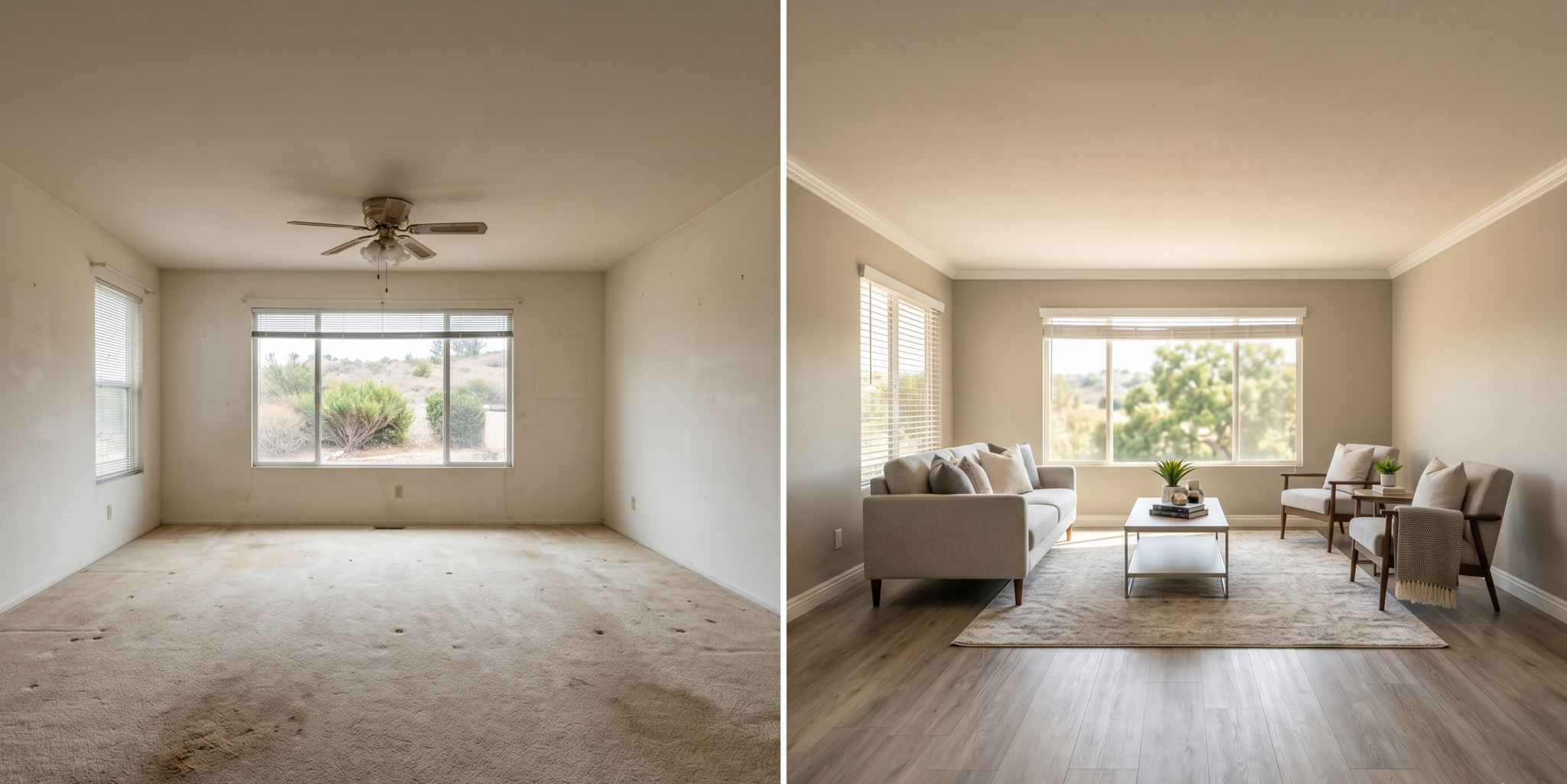
From 25 Vacant Days to 4 - A $4,900 Single-Turn Recovery
An owner in Scripps Ranch was averaging 25 days of vacancy and spending $7,800 per turnover event. Their previous manager was “passive,” waiting for move-outs to begin repairs.
The Palm Tree Intervention: We moved their lease expiration from December (low demand) to July (peak Military/Biotech relocation), pre-scheduled cleaners and painters to be on-site 4 hours after key return, and replaced flat smartphone photos with a 3D Matterport tour.
The Result: Vacancy Days reduced from 25 to 4. The owner saved $4,900 on a single turn - more than their entire annual management fee.
The Scripps Ranch result is not an outlier. It is the predictable output of a written protocol applied with discipline. The same playbook produces comparable results in La Jolla 92037, Pacific Beach 92109, and North Park 92104 - adjusted for the seasonal demand curves of each submarket.
Neighborhood Nuance & The PCS Cycle
San Diego’s market is highly seasonal, and the seasonality is driven by two distinct demographic surges that most landlords ignore at their own expense. The Permanent Change of Station (PCS) cycle for the Navy and Marine Corps peaks from May to August, and biotech relocations cluster around fiscal-year transitions.

If your unit turns in June, you will have ten applicants for every one unit. If it turns in December, your Days on Market will double. The PCS surge between May and August is the highest-leverage leasing window in the region.
Relocations for companies like Qualcomm and Illumina often happen at the start of the fiscal year. Aligning lease expirations with January and July onboarding cycles materially compresses vacancy.
We align your lease terms to these “surges” to ensure we are always leasing during peak demand, allowing us to be more selective with tenant quality while reducing vacancy. For deeper context on submarket-specific timing, our San Diego market trends analysis tracks these cycles quarter by quarter.
The 25-Point San Diego Turnover Audit
Below is the operator checklist we apply to every turnover under management. Each item is non-negotiable - missing any one of them creates either legal exposure, vacancy drag, or both.

Legal & Compliance (2026 Focus)
- AB 414 Check: Is the electronic deposit return path verified in your ledger?
- AB 628 Audit: Are the stove and refrigerator certified as “habitable” and recall-free?
- 21-Day Statement: Is the itemized deduction template ready for Day 1?
- Pre-Move-Out Inspection: Was the tenant provided their 14-day initial inspection rights?
- Fair Housing Ad Check: Has the listing been audited for “trigger words” or bias?
Physical Make-Ready
- Locks & Liability: Are all exterior doors re-keyed immediately upon possession?
- Safety Devices: Are smoke/CO detectors tested and documented with new batteries?
- Plumbing Stress Test: Are all angle-stops exercised to prevent hidden leaks?
- Water Heater: Is the seismic strapping compliant with the latest San Diego code?
- HVAC Health: Is the filter fresh and the condensate line flushed?
- Appliance Coil Clean: Have the refrigerator coils been vacuumed for AB 628 longevity?
- Deep Clean: Is the unit “White Glove” ready, including window tracks and fixtures?
- Paint Refresh: Are scuffs removed and colors matched to 2026 neutral trends?
- Flooring Audit: Is the carpet steam-cleaned and LVP checked for “lifting”?
- Lighting: Are all bulbs matching LEDs to reduce tenant-reported “outages”?
Marketing & Momentum
- High-Res Media: Do you have 20+ wide-angle photos and a 3D virtual tour?
- Show of Force: Is the listing syndicated to 50+ platforms (Zillow, MLS, HOMES.mil)?
- Lead Response Time: Are inquiries answered in under 2 hours?
- Pricing Data: Is the rent based on “Closed Comps” from the last 30 days?
- Self-Showing Tech: Can pre-qualified tenants tour via secure lockbox?
Operational Carry
- Utility Transfer: Is the SDGE “Landlord Agreement” active to avoid shut-offs?
- Landscaping: Is the curb appeal maintained during the 14-day turn?
- Insurance Check: Have you notified your carrier if the home is empty more than 30 days?
- HOA Rules: Have the new tenants been provided with the CC&Rs?
- Final Sign-off: Has an operator performed a final walkthrough before keys are handed over?
Frequently Asked Questions
How much is the average tenant turnover cost in San Diego in 2026?
Can I show my property while the tenant is still living there?
What is the 21-day security deposit rule in San Diego?
Is it better to lower the rent or wait for a better tenant?
What is Normal Wear and Tear in 2026?
What is AB 414 and how does it affect my deposit return?
What does AB 628 require for stoves and refrigerators?
How long does an eviction take in San Diego in 2026?
How does the PCS military cycle affect my lease timing?
Should I use a 3D virtual tour for my rental listing?
What does a professional turnover service typically include?
What happens after a tenant moves out?
Next Steps for San Diego Property Owners
The tenant turnover cost rentals incur is an operational emergency. As a performance-driven property management firm, our goal is to eliminate this friction through clinical execution.
Protect your income. Enforce standards. Operate with discipline.

Eliminate the Turnover Tax on Your San Diego Rental
Our clinical turnover protocol reduces vacancy days, neutralizes 2026 regulatory exposure, and protects your equity from the silent drain of operator error.
Schedule a Free Consultation