
The California Tenant Protection Act (AB 1482) has fundamentally reshaped the regulatory landscape for property owners. For San Diego landlords, staying compliant requires navigating a complex intersection of state statutes and local municipal ordinances.
This guide provides a comprehensive framework for independent landlords and portfolio owners to manage rent increases, understand just cause protections, and maintain a high-standard “compliance system” to protect their investments.
San Diego landlords also need to understand local tenant protections, including relocation assistance requirements in certain no-fault scenarios.
Key Takeaways
- AB 1482 caps San Diego rent increases at 5% plus local CPI, or 10% maximum, whichever is lower.
- San Diego requires 2-3 months relocation assistance for no-fault evictions, stricter than California’s one-month statewide requirement.
- Landlords exempt from AB 1482 must provide written exemption notices in leases or risk being treated as covered properties.
- Rent increase notices exceeding 10% require 90 days’ notice; errors in notices can trigger refund liability for landlords.
- Starting 2026, San Diego landlords cannot evict seniors or disabled tenants for nonpayment caused by federal benefit delays.
What is AB 1482 (Tenant Protection Act)?
AB 1482 is the statewide framework designed to prevent “rent gouging” and arbitrary evictions. It is built on two primary pillars:
- The Rent Cap: A limit on how much rent can be increased over any 12-month period (Civil Code 1947.12)
- Just Cause Protections: A requirement for landlords to provide a valid, legally recognized reason to terminate a tenancy after tenants meet specific occupancy thresholds(Civil Code 1946.2).
Plain-language summaries from city/county agencies are often easier to digest than raw code, and they commonly describe the “5% + CPI (or 10% max)” concept and just-cause structure.

Does This Apply to Your San Diego Property?
Determining coverage is the first step in risk mitigation. Rules change dramatically depending on the property type and build date.
Properties Commonly Covered
- Multi-family apartments: Generally covered if they were built more than 15 years ago.
- Single-Family Homes: Properties owned by REITs, LLCs (where at least one member is a corporation), or corporations.
- Mixed-Use Buildings: Residential units within these structures often fall under AB 1482 protections.
Properties Commonly Exempt
- New Construction: Buildings issued a certificate of occupancy within the last 15 years (this is a rolling date).
- “Mom and Pop” Single-Family Homes: Single-family residences and condos that are NOT owned by a corporation, REIT, or LLC with a corporate member-provided the owner has given the tenant specific written notice of the exemption.
Landlord Takeaway: Never assume you are exempt. Documentation is your best defense. If you fail to provide the required exemption notice in the lease, you may be treated as a “covered” property even if you qualify for an exemption. Learn how property managers help landlords reduce legal risk in situations like this.
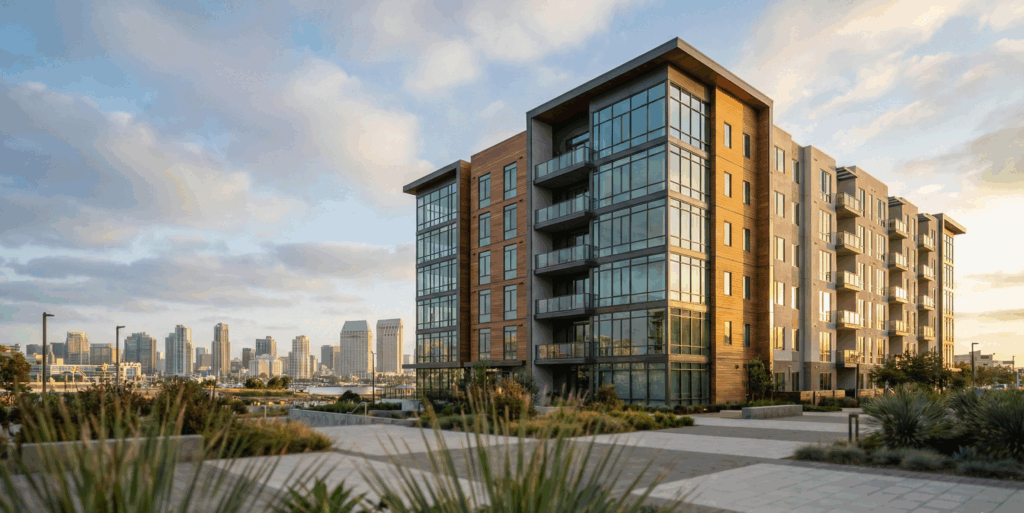
The 2026 San Diego Rent Cap Calculation: How much can you raise rent?
Under Civil Code 1947.12, the maximum allowable rent increase is 5% + the local Consumer Price Index (CPI), or 10%-whichever is lower.
Current 2025-2026 San Diego Rent Cap Data
For rent increases effective between August 1, 2025, and July 31, 2026, the local San Diego CPI figures apply. For a broader look at raising rent in San Diego, including timing and notice requirements, see our full guide for property owners.
| Scenario | Calculation | Max Increase |
| San Diego Regional CPI | 3.8% | 8.8% Total |
| Max Statutory Limit | 10.0% | 10.0% Total |

“Just Cause” Evictions & San Diego Local Layers
In San Diego, terminating a tenancy is no longer a matter of simply waiting for a lease to end. Once a tenant has occupied a unit for the required duration, you must have “Just Cause”.
At-Fault Just Cause (No Relocation Assistance Required)
- Nonpayment of rent.
- Material breach of the lease agreement.
- Maintaining a nuisance or using the property for unlawful purposes.
- Refusal to allow lawful entry after proper notice.
No-Fault Just Cause (Relocation Assistance Required)
- Owner/Family Move-in: The owner or a direct family member intends to occupy the unit. Learn how owner move-in evictions work in San Diego.
- Substantial Remodel: Major structural work that requires a permit and requires the tenant to vacate for at least 30 days.
- Withdrawal from Market: Taking the property off the rental market entirely.
The San Diego Difference: The City of San Diego has local ordinances that require relocation assistance payments equivalent to two months of rent for no-fault terminations, which increases to three months for seniors or tenants with disabilities. This is stricter than the statewide one-month requirement. If you ever need to formally remove a tenant, understanding how to evict a tenant in San Diego step by step can help you avoid costly mistakes.

Notice requirements for rent increases (the part that triggers disputes)
Under AB 1482, how much you raise rent matters-but how you notify the tenant matters just as much. Rent increases of 10% or less (combined within a 12-month period) require at least 30 days’ written notice. If the total increase exceeds 10%, a 90-day notice is mandatory. Notices must clearly state the current rent, the new rent, the effective date, and be served using legally recognized methods. Missing information, incorrect dates, or improper service can invalidate the increase and expose the landlord to refund claims, even months later.

Before You Issue Your Next Rent Increase
A CPI or notice error can create refund liability that survives a property sale. Palm Tree Properties reviews rent histories and notices for San Diego owners who want certainty before acting.
The “compliance system” landlords should use
Successful landlords treat AB 1482 compliance as an operational system, not a one-off task. This system includes documenting property eligibility, maintaining lease addenda with proper exemption or protection language, tracking all rent increases on a rolling 12-month basis, verifying CPI data before issuing notices, and retaining proof of service for every tenant communication.
When compliance is systemized, landlords can confidently increase rent when allowed, terminate tenancies when justified, and defend their decisions with documentation rather than assumptions.

AB 1482 Compliance Checklist for San Diego Owners (2026)
To maximize rent legally while minimizing litigation risk, landlords should treat compliance like bookkeeping.
- Coverage Audit: Confirm property age and ownership structure.
- Lease Addendum: Ensure required AB 1482 protection or exemption notices are in the lease.
- CPI Source Verification: Confirm the current regional CPI before calculating increases.
- 12-Month Lookback Log: Track all increases to ensure they don’t exceed the annual cap.
- Notice Timing: Provide 30-day notice for increases of 10% or less; 90-day notice may be required for larger cumulative increases.
- Relocation Budgeting: Factor in San Diego’s 2-3 month relocation fee for no-fault evictions.
- Due Diligence File Prep: Maintain signed service proofs for all tenant communications.
- Appliance Maintenance: Ensure working stoves and refrigerators are provided per 2026 requirements.

What happens if you violate AB 1482 or local tenant protections?
Violations can trigger consequences that extend far beyond a simple rollback of rent. Tenants may be entitled to recover excess rent paid, statutory damages, attorney’s fees, and relocation costs if a termination is deemed unlawful. In San Diego, local ordinances can compound liability by adding higher relocation assistance requirements and tenant defenses during eviction proceedings. Understanding how much a California eviction can cost is essential before any dispute escalates.
These risks often surface during disputes, court filings, or property sales-making past noncompliance a lingering liability that can reduce value or delay transactions. Landlords who have faced fair housing violations know how quickly these issues can compound.

When a property manager makes the most sense
A professional property manager becomes most valuable when regulatory complexity outweighs the cost of self-management. Owners with multiple units, mixed-use properties, long-term tenants, or value-add strategies face higher exposure to notice errors, relocation miscalculations, and procedural mistakes. A compliance-driven manager not only handles day-to-day operations but also protects asset value by ensuring rent increases, terminations, and documentation align with both state law and San Diego’s local requirements-reducing legal risk while preserving long-term returns.

Partner with Palm Tree Properties
Navigating the 2026 San Diego rental market requires a sophisticated approach to operations. Whether you are managing a single-family home or a portfolio of multi-family assets, Palm Tree Properties provides the local expertise and systems-based management you need to stay compliant and profitable.
We help San Diego landlords protect their investments and make sure that they’re following the laws that actually matter. If you’re looking for a property management company that knows this market inside and out and cares about bringing you the best possible returns, let’s talk.
Request your free rental property evaluation and see what we can do for your investment.
FAQ
- Does AB 1482 apply to mixed-use buildings?
Yes. While the commercial ground-floor tenant is not covered, the residential units above are subject to AB 1482 if they meet age and ownership requirements.
- Can improper notices delay a property sale?
Absolutely. Procedural mistakes often cause delays in regaining possession or lead to rent rollback claims, which are significant risks during due diligence. - How does AB 1482 affect value-add investment strategies?
Investors must factor in “No-Fault” relocation costs and stricter “Substantial Remodel” definitions when planning renovations. If you’re considering a value-add retail center in San Diego, understanding these rules is essential. - Is an ADU or JADU covered by AB 1482?
Generally, if there is more than one unit on the lot (including an ADU), the property may lose its single-family home exemption and become subject to AB 1482. Review the San Diego ADU rules for property owners to understand how this affects your specific situation. - What happens if a federal benefit delay causes a tenant to miss rent?
Starting in 2026, San Diego landlords cannot evict seniors or disabled tenants for nonpayment if the missed rent is caused by federal benefit delays. Understanding the value of long-term tenants can help you build stronger relationships that weather these kinds of disruptions.