This is exactly where apartment maintenance coordination becomes one of the most valuable functions a property management company provides. At its core, it’s the structured process of receiving, triaging, assigning, tracking, and closing out maintenance requests - all while keeping owners well-educated and tenants satisfied. It sounds easy. But in practice, it requires systems, reliable vendor relationships, and steady communication at every stage.
For owners and investors, poor maintenance coordination doesn’t just create problems - it can directly affect asset value, tenant retention, and long-term operating costs. A well-run coordination process protects your property and your returns. A disorganized one quietly erodes both.
This guide breaks down how property management maintenance requests are handled inside a professionally managed building, from the second a tenant reports a problem to the second it’s resolved and documented. If you want to know what your management team should be doing - and how to hold them accountable - you’re in the right place.
Key Takeaways
- Maintenance coordination involves receiving, triaging, assigning, tracking, and closing requests while keeping owners informed and tenants satisfied.
- Top-performing property management teams complete the full maintenance cycle-request to invoicing-in approximately 2.7 days.
- HUD, Section 8, and LIHTC programs legally require emergency repairs within 24 hours and non-emergency repairs within 30 days.
- Average maintenance spend runs around $1,098 per unit annually, with labor representing a significant portion of total costs.
- Buildings maintaining 90%+ preventative maintenance compliance experience 60-75% fewer emergency repairs, reducing costs and tenant disruption.
What Apartment Maintenance Coordination Actually Involves
Maintenance coordination is a structured process with defined roles and moving parts. At the center of it is the property manager, who acts as the point of contact between tenants and the people who do the repair work. That work gets carried out by either in-house maintenance technicians or outside vendors like plumbers, electricians, and HVAC contractors.
When a tenant submits a request, it doesn’t just land on someone’s desk and wait - it moves through a system from intake to assignment to scheduling to completion, and someone is responsible for each step along the way. The property manager’s job is to keep that movement going without things getting dropped or delayed.
To understand the scale of this, consider that property management firms across the U.S. collectively oversee more than 44 million rental units. At a rate of four to six maintenance requests per unit per year, that can add up to hundreds of millions of work orders being processed annually. A single mid-size apartment building can generate dozens of requests every month.
That volume is why coordination has to work as a system instead of a loose collection of tasks. If you don’t have structure, the same request might get logged twice or not at all. A vendor might show up without the right information, and a tenant might wait weeks for a repair that should have taken days.
The roles within that system are fairly clear. Property managers handle communication, documentation, and follow-up. Maintenance technicians manage work within their scope and flag anything that should have a licensed contractor. Vendors are brought in for specialized or regulated work and are usually managed through service agreements that set expectations around response time and cost.
Good coordination keeps all three groups in sync. A property manager needs to know what a technician can realistically manage and when a licensed vendor is the right call. Technicians need accurate information about what the problem is before they walk into a unit. Vendors need scope and access instructions to do their job without delays.
It’s a system with handoffs, and the quality of those handoffs shapes how the whole thing performs - it’s what separates a well-run maintenance operation from one that frustrates tenants and drains staff time.
How Maintenance Requests Are Triaged, Tracked, and Assigned
Once a maintenance request comes in, the first job is to figure out how urgent it is. Not every request needs the same response speed, and treating them the same is one of the fastest ways to burn out a maintenance team. A leaking roof and a broken cabinet handle are both worth fixing. But they are not the same problem.
Most management teams sort requests into two or three priority levels. Emergency items - things like gas leaks, no heat in winter, or flooding - go right to the top and need same-day attention. Everything else gets ranked by how much the issue can affect the tenant’s ability to live comfortably in the unit. A non-functional oven, just to give you an example, sits much higher on the list than a scuffed baseboard.
After triage comes assignment. The coordinator looks at who is available, what skills the job needs, and whether the work goes to an in-house tech or an outside vendor. This step can slow things down if the system is disorganized, because back-and-forth between the coordinator and the vendor eats time before any work starts.
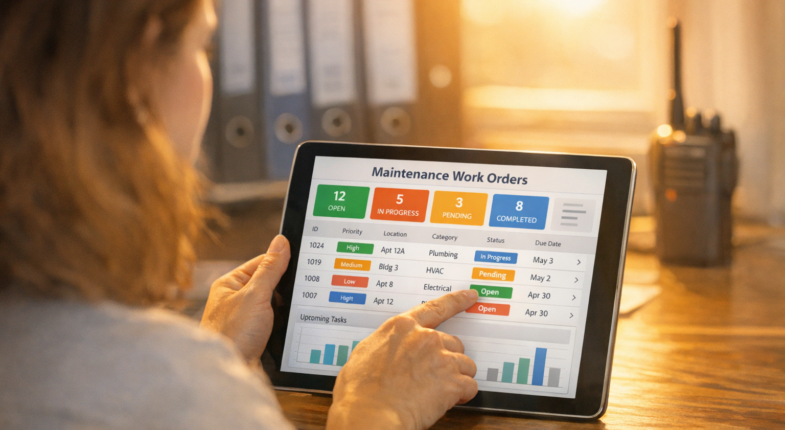
Property Meld analyzed over 10 million work orders and found that top-performing property management teams complete the full cycle - request submission to invoicing - in around 2.7 days. That is a helpful benchmark to hold in mind. Most teams land somewhere slower than that, and the gap usually comes from delays in the assignment stage instead of the repair itself.
Tracking is what keeps this honest. A work order system logs when a request came in, who it was assigned to, and what the latest status is. Tenants stay informed without having to chase anyone down, and owners get a paper trail that’s helpful if a dispute ever comes up.
A functional triage system beats a chaotic one not only in speed but also in how vendors get paid, how warranty work gets documented, and how quickly a team can spot patterns - like a unit that keeps generating plumbing calls, which might point to a bigger underlying problem. The next section looks at how legal timelines factor into this.
Legal Timelines and Compliance Rules Owners Need to Know
Affordable housing programs carry legal maintenance obligations - and depending on the funding behind your property, that clock has legal weight. Programs like HUD, Section 8, and the Low-Income Housing Tax Credit (LIHTC) each set maintenance deadlines that owners are held to as a condition of participation.
The general rule across these programs is straightforward. Emergency repairs need to be completed within 24 hours and non-emergency repairs within 30 days. These aren’t internal benchmarks - they’re compliance thresholds that inspectors and housing agencies can and do check.
Missing those deadlines puts your subsidy eligibility at risk. For Section 8 and LIHTC properties in particular, a pattern of late repairs can trigger formal findings during an inspection. That can mean having to repay tax credits or losing the ability to collect housing assistance payments until the property is brought back into compliance.
Liability doesn’t always arrive with a warning. A tenant who reports a hazardous condition gives you a documented paper trail, and if the repair isn’t completed in time, that record can be used in a legal or regulatory proceeding. Good coordination software timestamps every step of the process, which gives you a defensible log of what happened and when.

A well-run coordination system earns its place in less obvious ways. Beyond getting repairs done faster, it has the ability to prove that you responded correctly - documentation that protects you in an agency audit or a tenant dispute.
Owners who self-manage without a structured system use memory or scattered email threads to track completion; it’s a hard position to be in when a housing authority asks you to show proof of a repair timeline from six months ago.
| Repair Type | Required Completion Window | Programs That Apply |
|---|---|---|
| Emergency (e.g. no heat, gas leak) | Within 24 hours | HUD, Section 8, LIHTC |
| Non-emergency (e.g. broken fixture) | Within 30 days | HUD, Section 8, LIHTC |
How Maintenance Costs Are Reported and What the Numbers Tell You
Once compliance is handled, the financial side of maintenance can become the next thing to get comfortable with. Managed buildings track spending carefully, and the reports that come from this process tell you quite a bit about where your money actually goes.
A helpful benchmark comes from research across more than one million units. The NAA, IREM, and BOMA put average maintenance spend at around $1,098 per unit each year. That number gives you a point of comparison when looking at your own property’s costs.
It is worth understanding what drives that spend. Across nearly 400 communities, service teams put in about 19 hours per week on scheduled maintenance alone - before any reactive work comes in. Labor is a significant part of the total cost, and seeing it broken down this way helps the numbers make more sense on a report.
When you review maintenance financials, the goal is to look at patterns over time instead of responding to any single month. A spike in spend after a seasonal inspection is expected. A steady increase with no clear reason is worth a conversation with your management team.
Your property management company should give you access to reporting instead of just totals. You want to see cost by category, cost by unit or building area, and how labor compares to parts and materials. These breakdowns are what make a report helpful.
For owners who want to go deeper, the Operations Guide in the C Hub covers financial reporting in more detail - it connects maintenance data to wider property performance so you can see how spending relates to occupancy, asset condition, and long-term planning.
The numbers themselves are not tough once you know what to look for. A managed building produces a paper trail by design, and that trail is one of the most helpful tools an owner has.
Putting It All Together - What Good Coordination Looks Like for Your Building
The financial case is equally compelling. Buildings that maintain strong preventative maintenance compliance - usually 90% or above - see 60-75% less emergency repairs. Fewer emergencies mean lower reactive costs, less disruption for tenants and less pressure on budgets that were never designed to absorb surprise expenditures. Owners who treat maintenance coordination as a strategic priority, instead of a reactive necessity, are the ones who see that difference reflected in their bottom line year after year.

For an overview of workflows, vendor management protocols and compliance checklists for your building, the OPC Operations Guide is available in the C Hub - it’s a helpful reference to everything covered here - useful whether you’re onboarding to a managed arrangement for the first time or looking to tighten up an existing operation. Start there and you’ll have a picture of how the pieces fit together for your property.
FAQs
What is apartment maintenance coordination?
Apartment maintenance coordination is the structured process of receiving, triaging, assigning, tracking, and closing maintenance requests while keeping owners informed and tenants satisfied.
How fast should maintenance requests be completed?
Top-performing property management teams complete the full maintenance cycle in approximately 2.7 days. Emergency repairs under HUD, Section 8, and LIHTC programs must be completed within 24 hours.
What are the legal maintenance deadlines for affordable housing?
HUD, Section 8, and LIHTC programs require emergency repairs within 24 hours and non-emergency repairs within 30 days. Missing these deadlines can risk subsidy eligibility and trigger compliance findings.
How much does apartment maintenance cost per unit annually?
Research from NAA, IREM, and BOMA puts average maintenance spend at around $1,098 per unit each year, with labor representing a significant portion of total costs.
How does preventative maintenance reduce emergency repairs?
Buildings maintaining 90% or above preventative maintenance compliance experience 60-75% fewer emergency repairs, reducing reactive costs and minimizing disruption for tenants.
Ready to Talk About Your Multifamily Property?
Palm Tree Properties helps San Diego owners with reporting, maintenance, vendor oversight, and day-to-day management. Schedule a free consultation and see how we can support your investment.
Schedule a Free Consultation